Pax Indica: India and the World of the Twenty-first Century by Tharoor Shashi
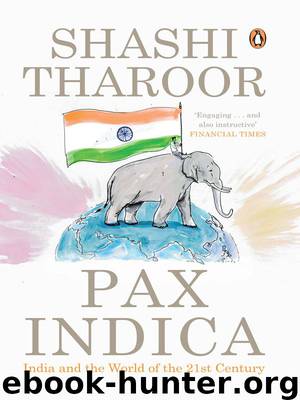
Author:Tharoor, Shashi [Tharoor, Shashi]
Language: eng
Format: epub, mobi
ISBN: 9788184756937
Publisher: Penguin Books Ltd
Published: 2013-06-15T00:00:00+00:00
In this view, the United States should support policies to strengthen India—including the nuclear deal—even if India remained wilfully independent on certain issues, because it would be good for the United States to do so. To Tellis, ‘the real issue boiled down to how Washington could assist the growth of Indian power so as to secure its larger global aims at lowest cost to itself’.
Neither scholar succumbs to the crude ‘what can India do for us?’ reasoning of many American politicians; Tellis, in effect, suggests that the United States has a stake in India’s success even when no direct benefits to Washington accrue from it—since a successful India is an asset for the United States’ own geopolitical vision of the future world order and ‘itself becomes New Delhi’s strategic bequest to Washington’. Tellis’s only caveat is that his argument for backing Indian success applies ‘so long as it is not used to undermine America’s vital interests’. In turn, Tellis ‘expects that New Delhi would see cooperation with Washington as being fundamentally in its own interest—and, by extension, act in ways that confirm this expectation whenever possible. Such responses would materialise not so much out of gratitude to the United States but because aiding the preservation of the American-led global order, in contrast to, say, acquiescing to the rise of a Chinese alternative, is necessarily consistent with India’s own vital national interests.’
Tellis served as an adviser to the Bush Administration and to its ambassador in New Delhi, Robert Blackwill, and it is safe to accept that his view both informed and reflected the administration’s thinking on relations with India. It helped, of course, that Indian economic reforms since 1991 had transformed the land of the tortoise-like ‘Hindu rate of growth’ into a rising economic power by the time Bush was elected, and a decade of post–Cold War geopolitics had ended all traces of the sympathy in New Delhi for the Soviet Union that the Republicans used to despise. India’s democracy was itself a source of deep fascination for President Bush, as was the country’s pluralist way of dealing with its own diversity (he was known to have remarked with admiration upon the fact that in 2004 India’s elections were won by a woman of Italian Catholic background who made way for a Sikh to be sworn in as prime minister by a Muslim President). Bush could see no reason why the two giant democracies could not make common cause in pursuing compatible global interests, and he had little patience for the non-proliferation orthodoxies that had ostracized India after the 1998 nuclear tests. The Indian exception was born.
In Tellis’s telling, Washington under Bush perceived a ‘strong compatibility in values’ which was ‘reinforced by the growing recognition that India’s interests increasingly converged with those of the United States’. Abstract considerations of a global balance of power favouring ‘freedom’ were supplemented by far more hard-headed considerations of both countries’ targeting by the forces of Islamist terrorism, especially after 9/11. Tellis puts it well when
Download
Pax Indica: India and the World of the Twenty-first Century by Tharoor Shashi.mobi
This site does not store any files on its server. We only index and link to content provided by other sites. Please contact the content providers to delete copyright contents if any and email us, we'll remove relevant links or contents immediately.
| Arms Control | Diplomacy |
| Security | Trades & Tariffs |
| Treaties | African |
| Asian | Australian & Oceanian |
| Canadian | Caribbean & Latin American |
| European | Middle Eastern |
| Russian & Former Soviet Union |
The Secret History by Donna Tartt(19092)
The Social Justice Warrior Handbook by Lisa De Pasquale(12190)
Thirteen Reasons Why by Jay Asher(8912)
This Is How You Lose Her by Junot Diaz(6888)
Weapons of Math Destruction by Cathy O'Neil(6281)
Zero to One by Peter Thiel(5802)
Beartown by Fredrik Backman(5756)
The Myth of the Strong Leader by Archie Brown(5509)
The Fire Next Time by James Baldwin(5447)
How Democracies Die by Steven Levitsky & Daniel Ziblatt(5219)
Promise Me, Dad by Joe Biden(5154)
Stone's Rules by Roger Stone(5088)
A Higher Loyalty: Truth, Lies, and Leadership by James Comey(4964)
100 Deadly Skills by Clint Emerson(4926)
Rise and Kill First by Ronen Bergman(4790)
Secrecy World by Jake Bernstein(4753)
The David Icke Guide to the Global Conspiracy (and how to end it) by David Icke(4720)
The Farm by Tom Rob Smith(4514)
The Doomsday Machine by Daniel Ellsberg(4490)
